


One of the most important , and my own personal favourite part, of the Glúnta Church Map is the Gospel Opportunities layer.
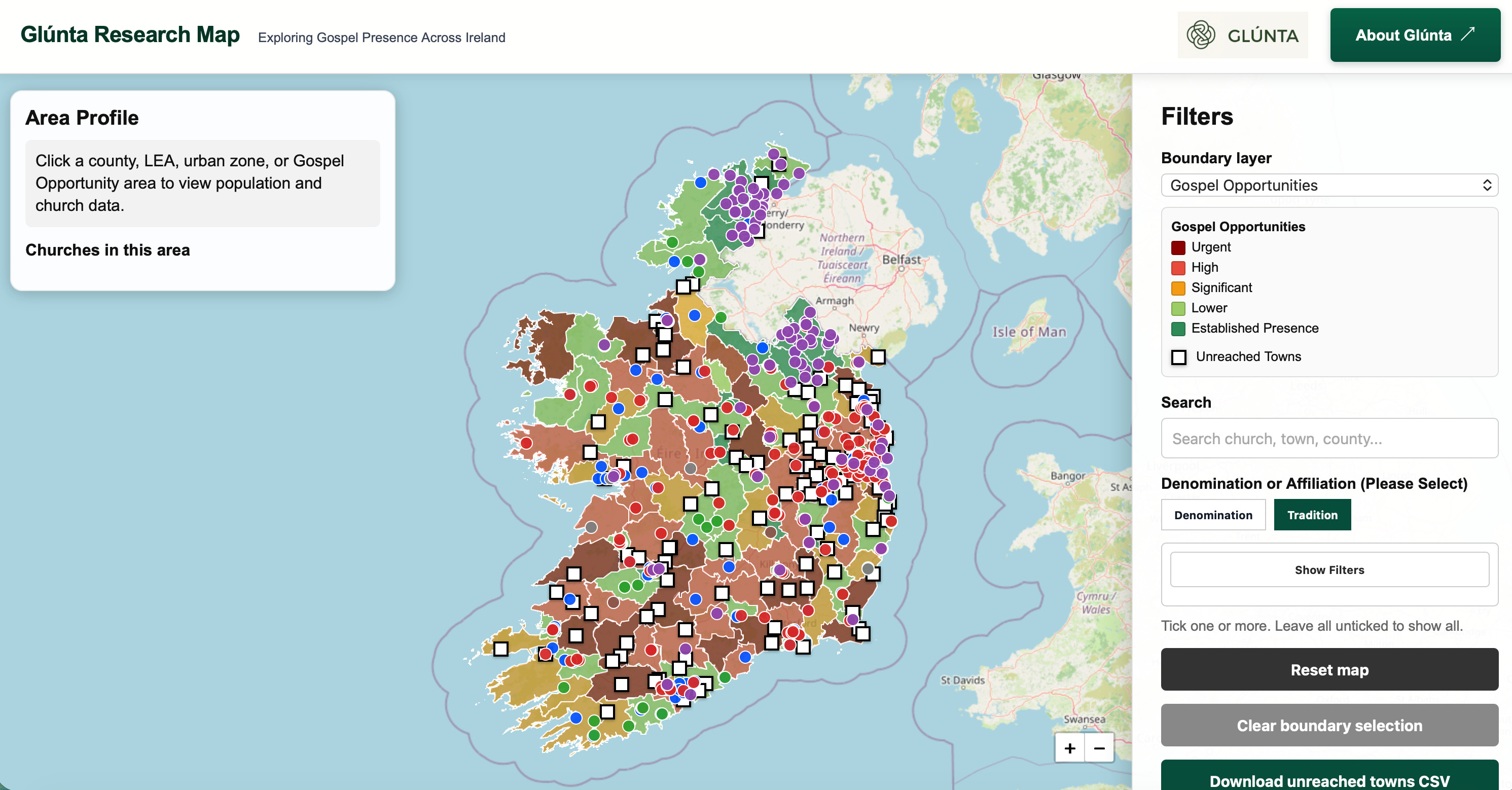
Most church or network maps show where churches are, and this is where I have begun in charting all the churches in Ireland. But if we stop there, we only see part of the picture. A colourful little dot tells us that a church is present, but does not tell us how many people live in the surrounding area, how isolated that church might be, whether nearby towns have any visible Gospel witness, or whether one small congregation is carrying the public evangelical presence for a large region.
The Gospel Opportunities layer is designed to help us look at the spaces as well as the dots. It has taken a fair bit of coding and help from some friends, but also was a developing part of the map that has stimulated a fair bit of conversation among testers. A lot of messages, and some +8min voice notes that bordered podcast territory! Yet, I do think this part of the map is the most missiologically helpful.
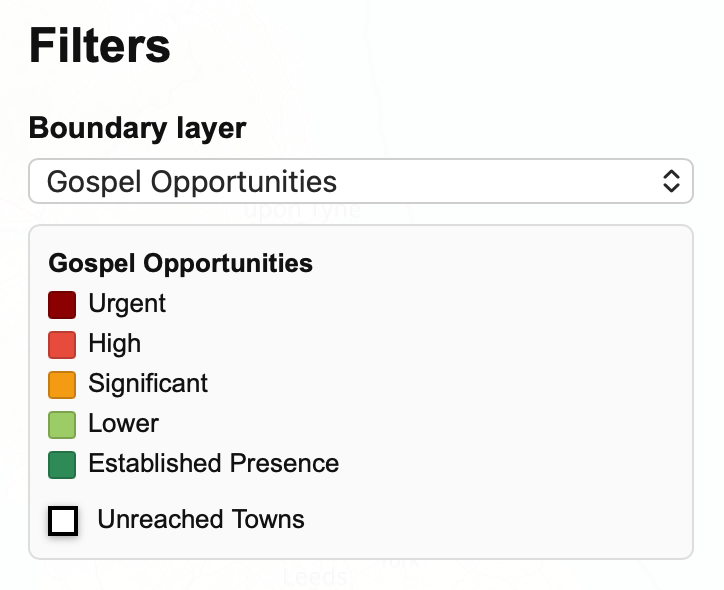
It does this by visualising areas of possible need in relation to church presence and population. In simple terms, it helps us ask where visible church presence may not be entirely able to reach a broader area, and gives a sense of ‘reachedness’. Some areas appear to have an established presence but have towns that are unreached. Others show lower, significant, or high levels of need. A few places stand out with particular urgency, especially where there is no clearly identifiable evangelical or Protestant church currently listed in the public data. It also gives us a sense that as much as cities appear saturated with churches, their concentration is in a specific area, and there are areas that perhaps require more missiological urgency.
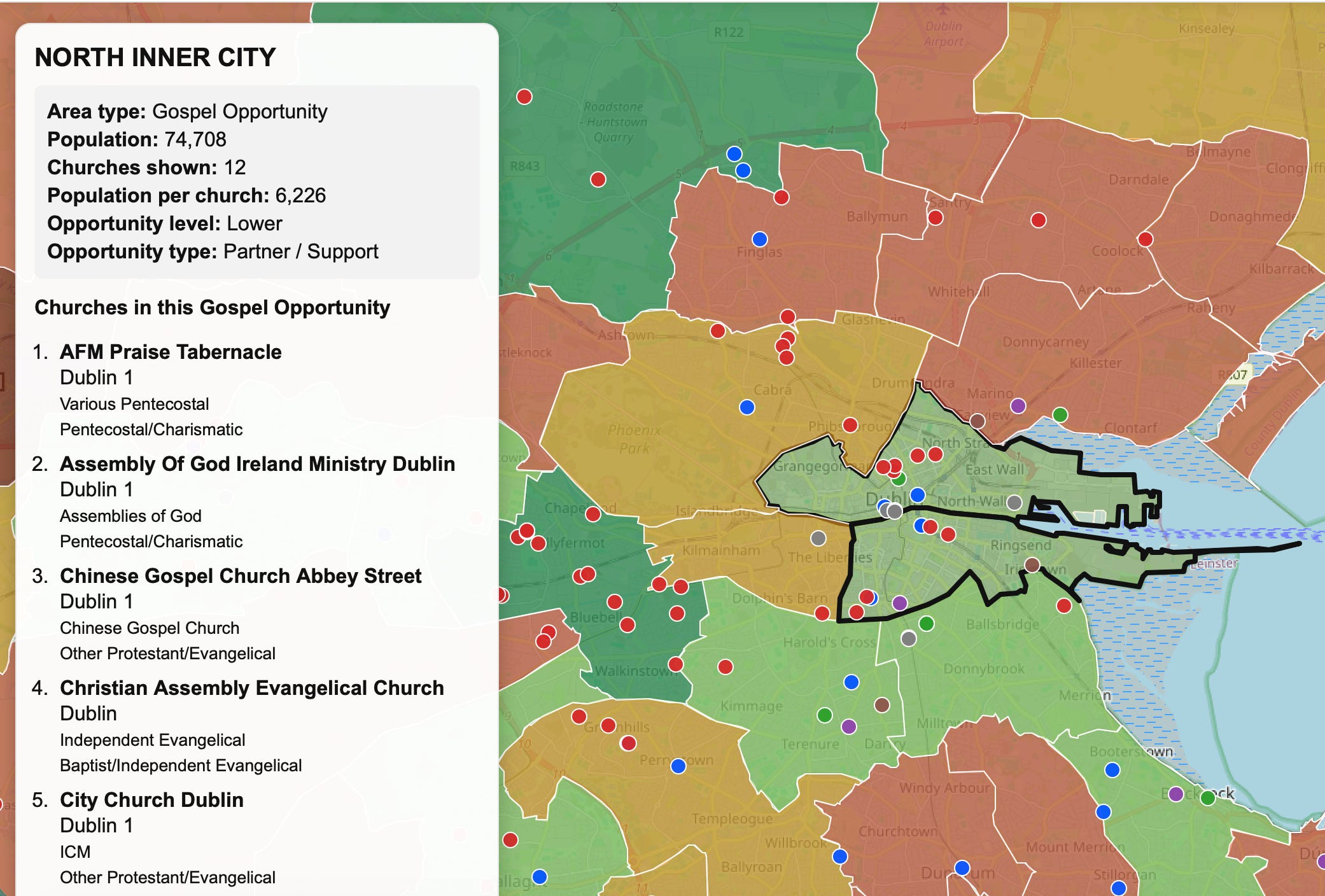
This is where the map starts to become more than a directory.
A directory tells us what exists, which of course is useful. Knowing how many churches there are, and where they are will be interesting to many. But mission also requires us to ask where there are gaps, where there is fragility, where there may be opportunity for partnership, and where prayer needs to become more concrete. The Gospel Opportunities layer does not answer all of those questions, but it does visualises them. And for me this is helpful because seeing things helps us begin to formulate ideas and vision.
I want to be careful here, because maps can show a lot of things. A coloured area on a screen can give the impression of certainty without on the ground knowledge. A category like “urgent” can feel stark. A phrase like “unreached town” can carry a lot more weight than we might have intended. So the language needs to be handled with a bit of humility. But it’s a starting point that I hope will enable conversations to happen. A friend told me once that someone has to throw a dart-board on the wall so that the game can start. For me, this is the dart-board.
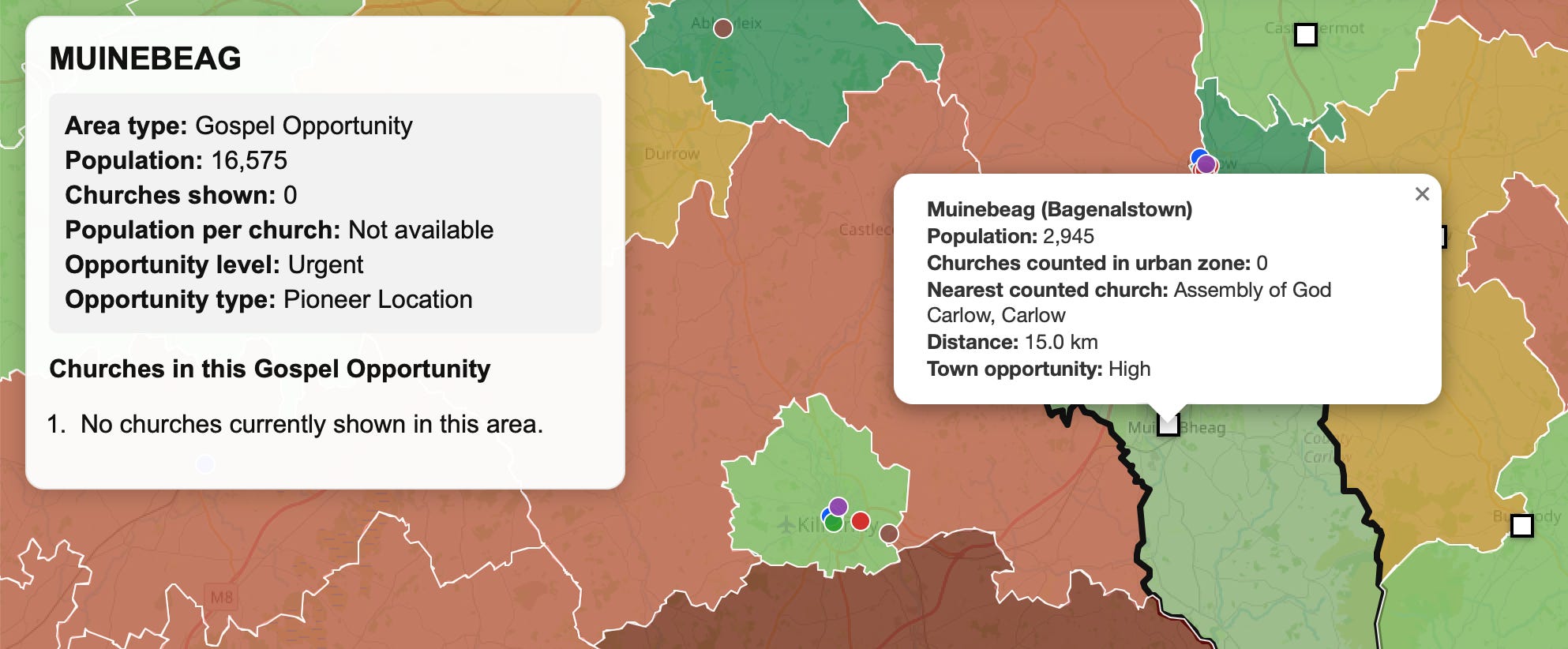
One thing I want to explain though is that when I use the phrase “unreached town” in this project, I do not mean that there are no Christians there. I do not mean there is absolutely no witness, no faithful believer, no home Bible study, no prayer, no informal evangelism, no Christian history, and no work of God hidden from public view. That would be far too strong a claim, and it would almost certainly be wrong in many cases. I mean something missiologically narrower and more measurable. From the public data currently available, there does not appear to be a clearly identifiable evangelical or Protestant church meeting there regularly in public worship. If I am wrong, or need amended or new data, please get in touch. This map works best if we can work together on the accuracy of the data.
Saying that a town is ‘unreached’ is a limited claim, but it is still significant. We can also download the lists of these towns for help in praying or planning. But whilst this map is missiological in posture, visible, gathered, public church presence matters. As we know, the New Testament does not imagine Christianity as merely private belief scattered invisibly through a region. The Gospel creates congregations. It gathers people into worshipping communities. It forms visible bodies of believers who preach the Word, share the sacraments, pray together, disciple one another, welcome outsiders, care for the weak, and bear witness to Christ in a particular place.
So when a town appears to have no clearly identifiable evangelical or Protestant church, that should at least make us pray. It should not make us dismissive of what God may already be doing there. It should not make us talk as though nobody has ever shared the Gospel in that place. But it should make us ask whether visible Gospel witness is absent, hidden, fragile, or difficult to find. That was my thinking behind the Gospel Opportunities layer.
It is not there to shame existing churches. Many churches are already stretched. Some are serving faithfully in places where the work is slow, lonely, and costly. A small dot on the map may represent decades of perseverance. We should see that and be thankful.
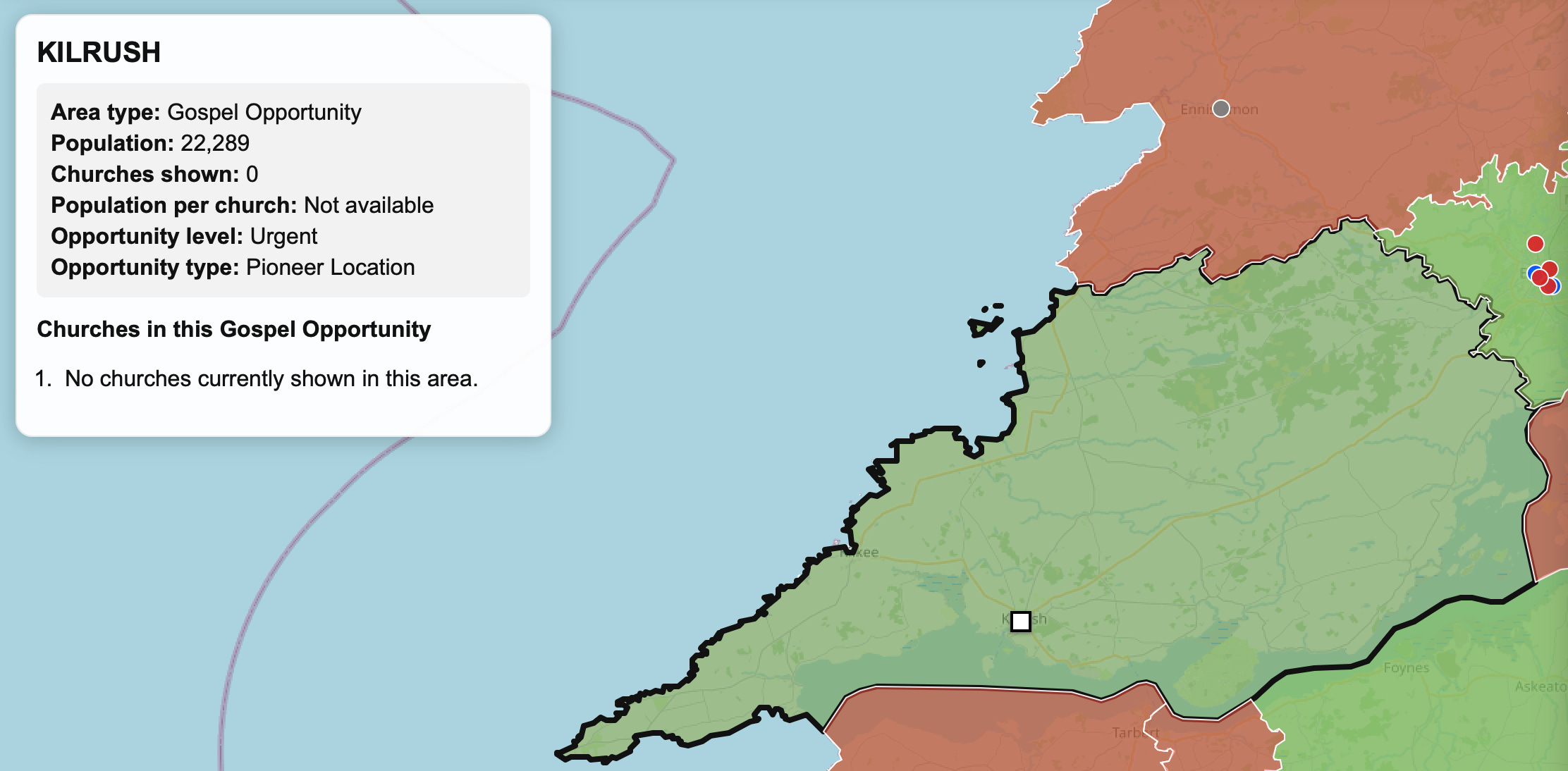
Nor is the layer there to create a simplistic league table of need. Mission is not a spreadsheet. Population ratios matter, but they do not tell the whole story. A town with no listed church may still be near a strong congregation in a neighbouring area. Another place may have a church on the map, but that church may be small, ageing, under-resourced, or unable to reach the wider population on its own. Numbers can help us see, but they must not replace wisdom and discernment. For example I was concerned at a large gap between churches, and couldn’t figure out why - turns out it was a mountain!
This layer is meant to help churches pray, plan, collaborate, and ask better questions. Where does visible presence seem established? Where does it look like there are big needs? Where are the gaps? Where might a denomination, network, or group of churches consider partnership? Where might existing churches need encouragement rather than competition? Where should we be asking the Lord of the harvest to raise up workers?
A dot on a map tells us where a church is. The spaces between the dots may tell us where to pray for next.